The Ride-Out rule
Cry MachoThe Ride-Out rule is the rodeo’s contest of endurance: instead of riding for a fixed number of seconds, a cowboy stays on a bucking bronc until he is thrown or the horse goes quiet. Conceived by Mike Milo as a way to revive a show that was falling short, it turns a simple change in riding conditions into a signature spectacle. Its success restores Mike’s status as a star, while its later, more dangerous form places his body and nerve at the center of the entertainment.
Origins and Operation
The Ride-Out began as Mike’s proposed answer to a practical problem: the rodeo needed a galvanizing event, something capable of arresting the audience’s attention and sending it away exhilarated. The existing competition rules imposed fixed limits—eight seconds on a bareback horse and ten on a saddle bronc. Mike suggested replacing that measured interval with an open-ended test: use a suitable bucking bronc, not an excessively wild one, and keep riding until the cowboy is bucked off or the animal settles. The finish would be determined by the encounter itself, not by a clock.
The rule thus makes the horse’s change of state part of the contest. A ride ends through one of two outcomes: the animal throws its rider, or it grows quiet beneath him. The bronc is not merely scenery for a timed athletic performance; its resistance determines how long the test lasts and which side prevails. What the rule calls a finish is also a visible transformation, from violent bucking to submission—or, if the cowboy loses his seat, to defeat.
From Program Innovation to Main Attraction
The Ride-Out was first presented as a special event at the end of the show. Its novelty drew newspaper attention and larger crowds, and the audience left screaming. The response made the new rule more than a technical variation on ordinary rodeo riding: it supplied the show with a climactic spectacle, and Mike became a star again. The event’s placement at the end mattered to its effect, giving the audience a final contest whose outcome remained unsettled until either rider or horse gave way.
After its initial success, Howard Polk changed both the Ride-Out’s position and its level of risk. He added another one immediately after the Grand Entry to strengthen the opening of the program, then began supplying Mike with fresh bucking stock for added excitement. The original proposal had specified a manageable bronc, explicitly not too wild; the newer horses were not gentle substitutes. This change reveals the pressure built into the rule’s popularity: once endurance became the attraction, a more difficult animal could make the same contest appear more thrilling, while also increasing the danger to the rider.
Mike Milo and Tabasco
At the featured Ride-Out, the loudspeaker announces the special event and identifies Mike as the rodeo’s star, citing his three National Finals victories, the Dallas Buckle for bareback riding, and nine Cattlemen Trophies. He is to ride bareback on Tabasco, introduced as hot. The introduction connects the rule’s general promise of an unresolved test to a particular public performance: a celebrated rider, a difficult horse, and a crowd waiting to see which will yield.
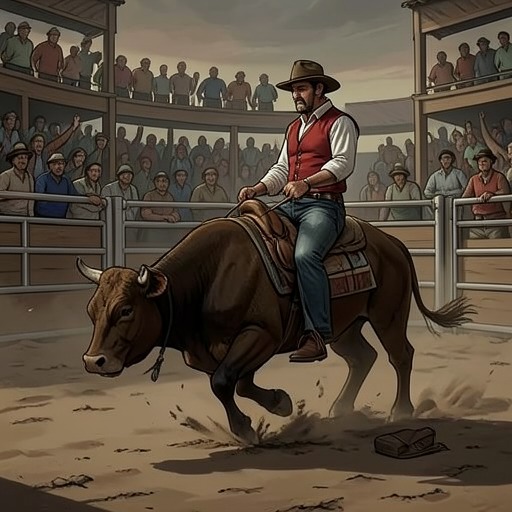
The chute boss tightens Tabasco’s flank strap; irritated, the stallion rears and bucks, and Mike drops onto his back. The horse erupts into the air and kicks at the boards. The contest does not end with the first burst of violence. It ends only when Tabasco is calm while Mike is still riding. The narrative marks that instant as Mike’s victory: he handles the subdued stallion easily, raises a hand in a courtly salute, and lifts his milk-white beaver hat to the cheering crowd. The contrast between the horse’s earlier eruption and Mike’s later delicacy makes the Ride-Out’s two possible endings legible in action: the rider could have been thrown, but instead the bronc goes quiet.
Consequences and Significance
The Ride-Out’s success depends on turning duration and uncertainty into spectacle. Fixed-time competition tells the audience when a ride is over; this rule withholds that certainty until the horse or rider breaks the contest. Its two possible finishes also give the event a compact dramatic structure: escalating resistance leads either to the cowboy’s defeat or to the horse’s submission. The crowd’s response confirms that the prolonged uncertainty works as entertainment, first drawing larger audiences and later sustaining the program’s excitement through an added opening Ride-Out.
In the Tabasco ride, the public result coincides with a private physical reversal. As Mike waves to the crowd, his arm no longer aches: the pain that had troubled him is gone, and he waves harder without pain. The scene does not explain why it disappears, but it makes the bodily change inseparable from the moment of victory. The Ride-Out therefore concludes on two levels: Tabasco has been subdued in the arena, and Mike briefly experiences relief in his own body. The rule that began as a device for saving a rodeo becomes the structure through which his endurance is tested, displayed, and rewarded.